Showing posts with label the Transformation. Show all posts

Friday, September 1, 2017

Beyond Male and Female: On Transgender & Non-Binary Genders


We have always existed, 
and we will continue to fight 
until we are all safe and free.”

Laverne Cox
______________________________
______________________________

Course Description and Outcomes

Gender is personal and political. Gender is not just a set of physical or mental characteristics but an ongoing social conversation between identities, expressions, and relations that fight to order how we define bodies, how we divide bodies, and what roles or values these bodies will possess. Histories and narratives form and repeat when readers follow debates on gender in society. These narratives influence cultural imagination with tales that reflect and resist public concepts of gender, sexuality, race/ethnicity, disability, and class. In this seminar, we explore how rhetoric and worldviews have worked together to form diverse genres of texts and embodiment that have come to be collected under the name, “transgender,” as well as other forms of gender beyond the binary categories of “male” and “female.” By tracing a cultural genealogy that spans the western Middle Ages to today, we map how texts in the history of gender reinforce and resist mechanisms of control. This course asks: how is gender not just something you have but something you do? How does the doing of gender shape your embodiment? How do the lack or existence of disability access and gender-neutral bathrooms create and enforce divisions without active intentionality in the community that occupies the place? As part of the course, participants will engage with a variety of religious, scientific, and cultural texts, including selections from the Bible and Greco-Roman mythology, the Diagnostic and Statistical Manual of Mental Disorders (DSM-5), films such as the Danish Girl and the Transformation, as well as the biographies of Caitlyn Jenner and Jazz Jennings.

Course Objectives (Reflecting SAGES Learning Outcomes)
By the end of the course you will be able to

  • Sympathize across multiple perspectives in academic conversations 
  • Analyze ethical debates and offer critical inquiries 
  • Research relevant historical contexts and scholarship 
  • Argue in written and oral forms according to the dialectic method 
  • Honor the diversity of genders and be communicate them clearly


______________________________
______________________________

Selections from the Reading List

Beyond Male and Female (or as my students say the B[a]MF seminar) is divided into two primary sections: the Binary and Beyond the Binary. The first half of the class focuses on the history of the gender binary, where does it come from and why do we use it? These questions are tackled over two subsections focused around Religion and Science. Throughout this section, students analyze the arguments historically made in support of the binary and learn to see the cracks in the argument as well. In the second section, Beyond the Binary, the course focuses on issues in the Intersex and Transgender communities. The intersex section begins with mythic origins, moves through modern science, and then concludes with two memoirs. One memoir tells the story of a non-binary intersex person and the other one tells the story of a "trans" woman intersex person). The final weeks of class are spent examining transgender and its intersections with disability, class, race, and age. How does being transgender influence how we experience other parts of our lives and how do other parts of our identity influence how we experience transgender?


----------------------------------------


Section 1: the Binary

Religion

  • The Bible, 
    • “Genesis 1-2,” 
    • “Leviticus 21-23,” 
    • “Isaiah 56,”
    •  “Matthew18-19” 
  • Nicholas Constas (Trans.), The Life of Saint Marinos 
  • Susana Aiken and Carlos Aparicio (dir.), The Transformation (1996) 
  • Caitlyn Jenner, Secrets of My Life


Science
  • Heldris of Cornwall, The Romance of Silence
  • Dylan Scholinski, The Last Time I Wore A Dress
  • Tom Hooper (dir.), The Danish Girl (2016) 
  • Leelah Alcorn, Transgender Queen of Hell 
  • Diagnostic and Statistical Manual (DSM-5) 

----------------------------------------

Section 2: Beyond the Binary

Intersex and Non-Binary Identities
  • Plato, “Tale of Aristophanes,” 
  • Ovid, “Tale of Hermaphroditus” 
  • Anne Fausto-Sterling, Sexing the Body, 
    • “Dueling Dualisms” 
    • “Do Sex Hormones Really Exist?” 
  • Hida Viloria, Born Both
  • Thea Hillman, Intersex 

Transgender and Intersections of Disability, Race, Class, and Age
  • Eli Clare, Exile and Pride 
  • Janet Mock, Redefining Realness 
  • Jazz Jennings, Being Jazz

______________________________
______________________________

Sunday, August 30, 2015

Eunuch Facta: Denaturalizing Sex in the Transformation


"If I still could 
have the choice..."

The Transformation
_________________________

The following is part 2 of an ongoing series
on Exemplum and Eunuchs
focusing on the Transformation (1994)
a documentary by Susan Aikin
_________________________

The Facta of the Eunuch

"Now what's really important is that you need to practice your English," the preacher tells Ricardo in a ministry planning session. "You see, I can tell people what you went through, but you went through it, you lived it. You see what I'm saying? I can tell them about it from my point of view but it's not as good as you." While Ricardo already speaks Spanish, recalling in his the voice of his history as Sara, Terry insists that in order to be a proper facta for his Texan, Christian message, Ricardo must be made to speak his words in English. As in any exemplum, a concept is defined in advanced and then a body is grabbed hold of as an example; then it begins to take shape as its exempla. The body is foreign to the English language of “eunuch” or “transsexual” (or any language) yet by cooperation takes on its shape as it is made readable and as it comes to articulate itself by the expected forms of the genre. [i] This means the body must be inscribed with verbal language (English scientific terms) as well as visual language (male clothing).

By conceding his need for Ricardo to tell his own story, Terry admits the subversive aspect of using exempla that threatens to invert the power dynamics of their relationship. The examplum depends on the inarticulate material facta of the trans body to ground its dicta, yet also needs it to speak back the dicta, the Word, the Logos, that frames and forms it. This agency is nonetheless contingent. The trans body exerts its power by co-operating with the authorities making an example out him. As a part in the operation of sharp-machines, the choices of the facta are dependent on how they meet with their associated dicta. Thus agency is not free, but contingent. It arises along point of the meeting, contact, even the violent edge where authorities work like a knife pressing against the skin of the trans body to carve out the form dictated by the exempla. 

Given that exemplum function as operations in social discourse, the sacrifice of Sara is at once physical and narrative. In one direction, the story of the eunuch cannot be told without the exchanging of finances and material resources. First, Ricardo needed to be brought on board. But moving Ricardo takes further exchanges. "Ricardo, as soon as they actually sign over the deed to the land to us,” says Terry, referring to a facility he is buying to house more trans converts to his mission, “we are going to be traveling to raise money for the buildings.” After Ricardo’s transformation, Terry has tapped a certain stream of resources that need to replenished and expanded if his operations are to continue. More space and more money are going to be needed for Christus Medicus to keep working his supposed miracles on new converts. More converts are necessary, given that Terry was able to convince Ricardo to join him primarily because he took advantage of Sara’s vulnerable physical and social position after finding out she was dying of HIV.

In another direction, the movement of money and bodies are dependent on the effectiveness of the story that Terry dictates and Ricardo evidences. “You," says Terry pointing at Ricardo, "are coming with me so you can tell it from your perspective." The authority he has as a preacher is itself contingent on the continual co-operation of storyteller and audience, preacher and layperson, dicta and facta. Terry cannot move around without Ricardo. This is why it is critical that Terry gets Ricardo on board. "Understand?" Terry asks, "You are going to be traveling all around the United States to tell people where you came from and help us raise money for the buildings. Understand?" The repetition of the question, "understand?" functions at first as an assertion of his authority, as the speaker of the dicta. This insistence also shows his need for Ricardo to consent his power, as facta. The authority needs to be understood. 


_________________________
_________________________

Co-Operating Power


The power of facta is not that they understands repeats the dicta in the same form, if that was the case than the dicta would be sufficient on its own, but that the materiality of the trans body can represent the doctrine in other modalities, especially visually. Terry does not just need people to hear about Ricard's transformation but to see material facts. For this, he not only needs Ricardo to work for him, he needs Sara. "We are going to send out a brochure - do you remember Sara?" Terry says to Ricardo showing him a picture of himself as he appears now. "This is going to be what's on the other side," he says pointing to a picture of Sara. "That's going to blow people away." For Terry's exemplum in the Transformation to work, he needs to show transformation. That means that he does not simply need any body. Terry’s cis-male body is not sufficient. Nor is Ricardo’s body. He needs the trans body to repeatedly perform its trans-formation. The new whole, the eunuch, needs the part that is cast away by the authority, to enact power. Sara must be repeatedly killed in sacrifice and resurrected to give Terry authority as Christus Medicus. 

The power and material resources that buy Ricardo’s cooperation, Terry in turn uses him to procure. "To me this is like a dream. I am a poor man. The poorest of the poor," admits Ricardo. "When I was a transvestite, people would say to me ‘Sara you are so beautiful.’ But they didn’t know how hurt I was inside; how much I wanted a home," says Ricardo. "But now I feel rich… rich in love. I’ve always had love, but life has been so hard on me." Ricardo is rich now, to which he adds (or corrects), “rich in love.” Far from being an abstract, transcendent belief in a cosmic force, Ricardo’s love is manifest in the riches that brought him off the street, given to him by Terry and his new wife, Betty. Ricardo’s new life comes into being out of this exchange of properties. Sara’s love and beauty are sacrificed to buy Ricardo new kinds of love: a home and finances.

Despite the church’s exploitation of Cbristus Medicus’s dicta and Ricardo’s facta, the dangerous contingencies that Terry’s mechanisms view as a threat and try to contain, are embraced by Betty who offers different approach to love than either eunuch or pastor. “Betty, there can be nothing between us,” Ricardo recounts saying to Betty. “Because I was a Transvestite for many years. I even have breasts still. And I am HIV positive.” Ricardo is well aware of the precariousness of his life. Parts of his life, particularly HIV, mark him as a threat to social wholeness. The potential life and love from Ricardo and Betty's bond would be terminal. “Are you sure you don’t mind my being HIV positive?” Ricardo asks Betty before the wedding, stressing the danger of sharing properties, including body fluids. Betty embraces the facts of his life, open to share her resources and allowing him to affect her. They do not have frequent sex, Betty admits. When they do, she too contacts the lasting material and social effects of hormones, heroin, and HIV. 

While not “transgender,” insofar as she binds herself to Ricardo, his vulnerability becomes her vulnerability as she shares in trans experiences of rejection and subjugation. When the couple went to get married, they are told, “you can’t get married in the church." When asked why they are being turned away the church tells him, “because of your past.” “We all have a past,” Ricardo replies. “Don’t you guys say that Christ cleanses us of our sins?”[ii] Like a surgeon cutting away parts of the past, baptism serves as ritual exemplum where the material washing in water signifies the spiritual dicta of being “born again.” Despite baptism’s ecumenicalism, the material facts of trans bodies allows for public challenges to the dicta, what “you guys [Christians] say,” of Christus Medicus’s power to mark an absolute separation of part and whole, of before and after. Opening the body of Christ to the facts of Ricardo and Betty’s love means cooperating with all parts of them.


_________________________
_________________________

Destabilizing Power

Contingency stresses precariousness and uncertainty because it acknowledges that truth is not absolutely in either the eternal, lasting dicta or the immediate, mutable facta. Rather, contingent operations and cooperation function through the contact of different genders, matters, beliefs, and temporalities. The life and love Betty and Ricardo share is not fixed, but are formed and reformed by the transforming contact between persons, past and present, and their mutual contact with Christus Medicus. “Now everything is fine," worries Ricardo, "but if I get sick... I hope you won’t abandon me in the hospital then.” Ricardo’s concerns with Betty’s love stress that the products of cooperation cannot be known in advance. “I know," Betty replies. " But I love you and I want to be with you!” Embracing uncertainty, the contingent facts of Betty’s embodied “faith” and “love” are distinguished from Terry’s rhetorical dicta. By her continual contact, Betty asserts that she is not a docile part of Terry's exploitative operations, but a co-operative with Ricardo.

In contrast to these critiques and abuses asserted by absolute all or nothing dicta, Betty offers a model of love as a radically positive and transformative dicta, the activity of continually stitching together disparate facts of different moments and embodiments. "Love is not just something that just happens in the beginning. Love is something that continues to grow. But love is not just something that’s a feeling either. Love is a commitment … that means when things aren’t going well you are still going to be there." Change, whether it is the shift from Sara to Ricardo, or the inconstancy of health, calls on love to sustain cooperation through transformation, constituting what Betty calls growth. Betty recalls that they have “talked about this [love and mutability] many times” and will continue to have check-ins. This love is not a once and for all dictum, a feeling or essence that a person has or not, but a lived fact between persons requiring risk and collaboration.

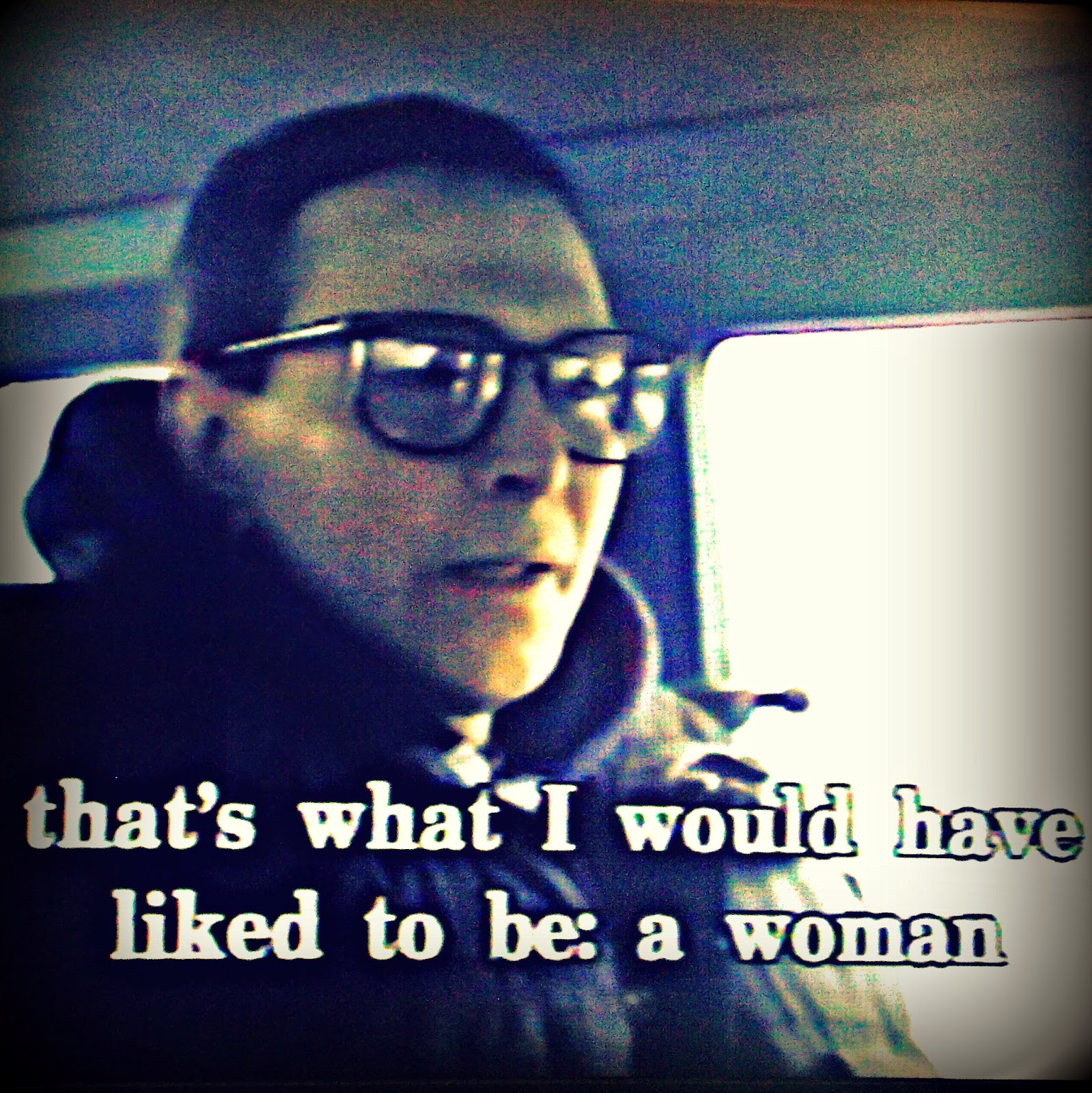
In the end, the wholesomeness promised Terry and Betty’s dicta on faith and love depends on the cooperation of eunuch facta formed and narrated to be its antithesis, the embodiments of fragmentation, inconstancy, and contingency. “I repented for my past life [as Sara]," says Ricardo narrating the Transformation’s final scene in a drive back from Texas to New York. "Now when I think about everything I lived I remember some of it as beautiful. Because the real truth is that I enjoyed it. That’s what I would have liked to be: a woman.” This contingency leads Ricardo to consider how he might reclaim the abandoned part of his life and return to living as Sara. Yet this change would likely involve ending his life as Ricardo, as Terry’s eunuch, and Betty’s husband. As Ricardo or Sara, the trans operative life is defined by castration, a “trans” position between separated parts of life that love might hold together if our sense of wholeness might be transformed. 

Before title screens announce Ricardo’s death, his final words leave viewers with the sense of the trans life’s precariousness. “If I could still have the choice, if I could change my life right now,” says Ricardo, “even now that I have my wife and everything, I would chose to be a woman.” While Ricardo imagines a free life, “if I could still have a choice,” he knows that the facts of his life are checked by contingency, by dictated limits set between his body and will. Undoing the change enacted by Chritus Medicus is impossible, only more changes, more castrations, more cuts; perhaps in the form of film cuts that slice together lives separated by time, circumstance and operations. Sacrificing parts of his life as Sara and Ricardo an exempla with competing presences and powers, the eunuch’s life stories implicate the audience as cooperative in the narrative. Choices still exist, but now shift to the hands of those who share in the eunuch’s story. All become eunuch-makers, implicated in crafting what becomes of the future of his pasts.

_________________________
_________________________

[i] Whereas most of his interviews occur in his Cuban Spanish, Ricardo uses the English terms "homosexual" "transvestite" and "drag queen" for sexuality and trans embodiment. Even by the 1990s, the scientific term "transsexual" was still fighting for legitimacy and use in the public, while another scientific terms, "homosexual" and "transvestite" were being considered expansive enough to include a wide variety of embodiments. Indeed, the trans body seemed to be so elastic so as to be able to pivot between a wider variety of exempla on both gender and sexuality. 


[ii] (Aikin & Aparicio). 

_________________________
_________________________

Eunuch Dicta: Naturalizing Sex in the Transformation


"You have stuck him 
in the Devil's face and said,
'Look what I can do'"

The Transformation
_________________________

The following is part 1 of an ongoing series
on Exemplum and Eunuchs
focusing on the Transformation (1994)
a documentary by Susan Aikin
_________________________

The Dicta of the Eunuch

“Let’s talk about Ricardo,” says Terry at the film’s opening, over a black-screen introducing the preacher as the primary narrative, the source of the dicta that will grab hold of Sara/Ricardo's body in order to narrate it into an exemplum on eunuchs in the 1990s. “Let’s talk about Ricardo,” he repeats as the film cuts to him sitting in a white room, on a white couch with a photo-album in hand.[i] As if acknowledging this absent presence, the scene ends with fading back again from the white room to a black-screen announcing the film’s title. This movement from white to black plays with notions of death and heavenly light. In these spaces suggest that Terry is speaking a metanarrative dicta from outside of Time. Terry's principles are associated with scriptural dicta, a priori, and then the body is produced as facta to demonstrate it. The "talk about Ricardo," depends on the showing and looking as key to the operations of power, yet depend on laying hands on Ricardo's body in order to grab him and shove him in people's faces.

Wrestling with the splitting of these two forms of the exempla by the 1990s, Terry works to turn Ricardo, understood as a “homosexual” or “transsexual” back into an eunuch and thus reclaim a public discourse into religious, locating the medical authority with Satan in order to hold up the scripture. Public and sermon authorities, function as different dicta that differently frames the factum of the eunuch body around which he pivots. This is the necessary turn in an exemplum where the dicta must give way to the power of the facta. Yet in all these cases, the authority of nature, religion, or medicine is exterior to the body it defines. In turn, the exemplary bodies are called upon to present their bodies as facta for the Christus Medicus proses to make incomplete bodies, taking control of them, in order to “make themselves eunuchs for the Kingdom.”

"First of all, you can probably focus on this," Terry says opening up his photo album, on the right a picture of Sara and on the left a picture of Ricardo. "Find Ricardo in here, so everyone is on the same page. This is Ricardo. When I met Ricardo he was Sara." Holding Sara and Ricardo's images as illustrative facta, Terry sets himself as the authority of the exemplum that will both not only verbal but visual. He orders the engagement, tells the audience where to focus, and defines the terms. "The thing that makes him unusual," says Terry, "he is enormously charismatic. He attracts people. He has power, he has presence. he has a personality." While Terry positions himself as the authority, but he needs Ricardo as factum in order to provide the physical "presence" in order to attract people to his message. For medieval audiences examples were highly persuasive, but for modern audiences steeped in scientific empiricism and materialism, the physical facts of a eunuch are indispensible to keep these sharp machines operational.

In order for the eunuch to be a proper operative, operations cut out parts of their body and history, in order to make it fit into the Church’s sexual regulatory operations. As such, Terry must renarrate Ricardo’s history to contain and cut down Sara’s presence. "Ricardo was there on that first night [the Church visited]" Terry recounts. "Sara," he corrects himself. "Sara was there on that first night." This slip is significant. It places Ricardo before Sara; a narrative it has Sara collaborate when the film cuts to her account of living as an unhappy man in Cuba before traveling to New York to live as a woman. Ricardo is the origin and the ending, while Sara is an interruption in the middle. "There was something missing,” Terry of Sara, “He never knew what it was to be a man.” Sara becomes the non-masculine part that is always already cut away, in the story an eunuch, lacking and castrated from birth, a pre-op subject for Christ’s reparative operations.


_________________________
_________________________

Naturalizing Authority

Ricardo’s latent “power” and Sara’s lingering “presence” in the film, however, remains dangerous to authorities and narratives that try to contain them. Holding images of Ricardo in his hand as he narrates the film, a mise en scène figurative of material dependences, Terry asserts the dominance of his dicta to frame and authorize the facta of the eunuch’s life story. Positioning himself as Christus Medicus, a kind of surgeon, Terry excuses laying hands on trans images and bodies by establishing a state of crisis that requires him to resolve. The poverty of trans women, the physical need for nourishment and medical care, becomes evidence of the supposed to lack of meaning without the dictum of the Church providing structure. This is especially true in cultures, medieval and modern, based on a “Gospel of Wealth” or “Prosperity Gospel” where financial success or failure is supposed to reflect degrees of God’s favor and wholesomeness.

Given the power of physical facts, the transformation of material circumstances is then key to defining Sara’s life as defined by a lack of resources and sexual wholeness and positioning Ricardo’s post-op life on the side of social fulfillment. This is done in part through the insertion of flashbacks to choice interviews with Sara from the Salt Mines. “I couldn’t wait to come [to the US],” says Sara in one talking head, “but now I am sorry I came. Because here if you have no money you are nothing.” The nothingness that Sara references is the absence of power and presence that money provides. Thus despite the promise of “the land of the free,” because she is denied material resources, she is not free to live as she will. As Sara says these haunting words, the screen freezes and the distinct voice of “Ricardo” from another scene speaks over the image. In a frozen moment before the change, we see the woman who is supposed to be “nothing” in this place linger as if to affirm that she remains an absent presence throughout the film. 

Indeed, a persistent irony of the eunuch transformation narrative is that its post-op “power” (Ricardo) is dependent on repeatedly invoking the “presence” of a supposedly erased and empty part of the pre-op past (Sara). In this, nothingness reveals itself not to be a state of non-being but rather the result of continual emptying to divide undesirable parts from the desired whole. Because nothing and being, part and whole, past and present are all operations in the same shape machine, the difference is not ontological but functional. While remaining intermeshed, the prior is made to be the unseen background to the latter’s foreground. This exchange is evident in when the film catches up the voice of Ricardo in the post-transformation time and space, where the still of Sara is replaced by the actively swaying Ricardo and the subtitle “Ricardo” appears on the bottom of the screen. “Dallas, Texas” appears on the screen as it pans over a dark room with dark furniture, where a Terry’s church thanks God for bringing Ricardo (into being) there. 

Through the ritualized operations of Chritus Medicus, Sara is made “nothing,” the missing something, to serve as a background for Ricardo’s thingness. Despite the dark enclosure that remains around them during the prayer, Terry calls the place where he brought Ricardo out from “a deep and dark hole.” This is where Sara worked the streets at night as a prostitute, injected drugs and hormones. Then, as later, she becomes a (penetrated) hole for the sake of her survival, but here she does so for pleasure as well. Sara’s location is indeed deep, as blood, semen, make-up, salt and semi-tangibles like love and community saturate each other, leaving traces of them in her blood. It is a dark space, relegated to the margins, taken off the street until the night work.[ii] It is this place, in the form of HIV/Aids that Sara carries deep in her body even as she migrates to Texas, remaining as the haunting material cause for Ricardo coming (into being) there. 


_________________________
_________________________

Spiritualizing Authority

While Christus Medicus’s authority depends on asserting the essential naturalness of the post-operative trans body, the exemplum needs to continually show the scars of the operations in order to evidence its power. There is a kind of double-meaning when Terry stands beside his church with Ricardo, thanking God for his transformation, praising, “You have stuck him in the devil’s face and you have said, ‘look what I can do’” The words are telling. The material facts of Ricardo’s new body and circumstances are perpetually being shoved in the face of Christians so that Terry can effectively tell them “look what I can do.” Rather than merely disturbing established gender discourses, the materiality of the trans body grounds scriptural rhetoric in a sense of physical realness. Rather than hiding the fault lines of reconstructed gender, the scars of trans bodies were showed off as a tool of social control, even as they offered their own forms of resistance.

Sometimes the scar that is erased and shown as part of the operation of sharp machines are not enough, the exemplum occasionally needs to open wounds as a reminder of the dangerous facts of living without the security of its framing dictates. “HIV affected [Sara/Ricardo’s] mind,” recounts one of his trans friends in an interview. “He grew afraid of dying alone on the streets. The Church was the only way out.”[iii] It is perhaps too easy to paint Sara's life on the streets as free and uninhibited. Yet it was physical and social operations already acting on Sara that drove her into the hands of Terry's Church. Sara had long been trained to trade her body for what she needed. She traded her skin as a prostitute in order to gain the currency to exercise limited claims over her body: paying for food, clothing, hormones and heroin; each operating between violence and pleasure, necessity and choice. At HIV’s arrival into the network, however, this machine became unlivable and Sara came to desire the closed system of the Church.

The gated community of Terry’s Born Again Church allows admittance only at a high price, yet promises to give life and future as it takes away another. “I thank God that I have AIDs,” says Ricardo in an interview, sitting comfortably in a plush chair and warm sweater, “I wouldn’t have come off the street, and I wouldn’t have devoted myself to God. I’m not a fanatic, I just love the way God loves me.”[iv] Nowhere in the documentary does Ricardo claim that he is fully gave himself to the church, although he participates in it. He says that God participates in him through the care he is given. He does not say he loves God (or His Church), but how God loves him. Across in the exemplum of the eunuch, sharp machines reveal the contingency of parts and wholes, dicta and facta working together with the promise of mutual benefit. In this way, even as it makes its trans operatives to be docile, it teaches them a critical tool for exploiting systems. This practice of cooperating in ways that at once erase and sustain, subjugate and empower, builds into the trans operatives a powerful capacity for contingency.

Along these scars and contingencies lie fault lines where the cooperative trans body always keeps one foot out of the door, never fully deployed in any form or machine in which it participates. Those eunuch machines, those transgender operations, freed from the yoke of pre- and post-op demarcations become trans operatives (like double agents) who may use the feature which is most used to subjugate them, their mutability, to effect changes on both sides of supposedly strict divides of gender and faith. Such operatives may effect wider change that offers a greater variety of livable lives and in a new sense of Christus Medicus, to “love the way God loves.” Yet even as exemplum position its exemplary bodies to potentially open up the meaning of dicta, it is not an easy slash and burn. Changing machines, especially those working towards love, require cooperation.

_________________________
_________________________

[i] (Aikin & Aparicio). 


[ii] Despite this failure to establish closure, once and for all, enclosure appears to be a pivotal desire for both Terry and Ricardo. McRuer notes that Ricardo’s environment is particularly closed-off and he is almost exclusively shown indoors, in houses, in Church or in a hospital (McRuer 116-119). Becoming sick from Aids, Ricardo appears anxious to exist in the supposed closed systems of church, house, and care.
[iii] ”(Aikin & Aparicio).

[iv] (Aikin & Aparicio).


_________________________
_________________________

Tuesday, May 6, 2014

Eunuchs for the Kingdom


For there are eunuchs, 
that were so born from their mother's womb: 
and there are eunuchs, 
that were made eunuchs by men: 
and there are eunuchs, 
that made themselves eunuchs for the kingdom 
of heaven's sake.

Gospel of Matthew 19:12


*************************************
The following is a transcript from the "Hauntings" panel
at the 19th Century Upstate New York Religions and Their Heirs
the Annual Meeting of the Eastern International Region
of the American Academy of Religion
at Syracuse University, May 3-4, 2014

*************************************

In a key scene in the 1995 film, the Transformation -- documenting Sara, a trans prostitute, who, after contracting AIDs on the streets of New York, converts to Born Again Christianity and adopts the masculine persona "Ricardo" -- when the preacher, Terry, presents a reading of his pupil that brings transgender into the fold of scripture. 

“There is nothing that is in the Bible that isn’t covered. Jesus said in Matthew 19:12… ‘some are born eunuchs, some are made that way men, and some make themselves eunuchs for the kingdom of heaven’… what he is speaking of is that there are people who are born without the desire for the opposite sex, but that doesn’t mean that they are same-sex motived. Satan says you are man, woman or gay. God says that you are man, woman or eunuch.” (Aikin & Aparicio).

Previous trans theory and scholarship on the Transformation has paid little interest in Terry’s Biblical typologies of gender, accepting the preacher's own flat reading of Matthew 19:12. Yet, while Terry’s invocation of eunuchs stresses the idea of sexual repression, performing what Eve Sedgwick calls a "reparative reading" of the preacher’s scriptural citation could cite manifold historical roles of eunuchs as the representative of the departed, as the cauterized embodiments of absence, and as sex slaves. What if we take scripture to mean (and allow) more than one of its readers intends? How might Born Again Christianity better allow for the transformation of trans bodies than neoliberal identity politics? Why stop the queer drive for appropriation, gaping openness and unnatural love at the Church doors? These are not just abstract questions, but a critique generated by Ricardo/Sara as she trans-formed the language and properties of Christianity to allow for a more a livable life.

In this paper I unpack Christ's words in Matthew 19:12, using different readings and translations (e.g. the Latin Vulgate, American Protestantism, Terry's paraphrases), to demonstrate how the Transformation uses the three eunuchs of scripture to offer three different histories for gender change (I. Woman, II. Man, III. Self), that speak with and against three neoliberal modes of codifying transgender in the mid 1990s as an identity (I. Original, II. Progressive, III. Individualistic). By offering manifold images that contradict one another, these eunuch narratives disturb attempts to define and homogenize trans bodies by playing different essentialisms against one another. Through this dialectical approach, the scripture and film moves us towards an orientation to "the Kingdom" that is neither absolutely natural or social, natural or super-natural, but widens the gaps in these delimited discourses to allow for properties to flow between delimited bodies. The Trans-Eunuch uses their place in the threshold, always between and across communities, to sustain the contradictions that bind desire and abjection, presence and absence, life and death.

There remains a pressing need for transformation in contemporary trans studies. “Born This Way” politics and models of transgender as artificial, man-made men, don’t escape Matthew 19:12, and the paranoid imperative in queer culture to cut ourselves off from a Christian past in order to move forward depends on the logic of castration and baptism. However we slice it, the eunuch still stands in the dark, haunting our queer kingdom with uncomfortable trans Christian narratives, demanding a yet more gaping openness and more unnatural love, without promises that we’ll survive such contingent alliances fundamentally unchanged.


*************************************
*************************************
I. From the Mother’s Womb

Trans bodies in the Transformation compel desires for origin stories by disturbing the sense of constancy by which neoliberalism makes its promises for coherent identity by embodying mutability. Lacanian psychoanalysis calls this crisis and desire the search for the Mother, a pun with a search for the capital-O "Other" (with God, or the Law of God, as the Other par excellence that promises an objective Real to undergird and generate our slippery subjectivity (Zizek, the Sublime Object of Ideology). The arrival at this metaphysical Womb in a sense promises to bring signifier and signified together, ending the free play of language as a series of specters of meaning, a Tomb, a figure-head that can be understood in religious terms as Apotheosis, the (M)other of a Trans persons essence (Zizek, the Monstrosity of Christ). 
When Terry signals that some eunuchs may be made, “de matris utero sic nati” (born from the mother's womb; Gospel of Matthew 19:12, Latin Vulgate), he gestures to the very desire for “Born this Way” origins that the film, and perhaps himself, desperately wants to assert for Sara, but ultimately denies. He is constructed like the historical eunuch, the dark body standing in the shadows, unnoticed until he is invoked to stand in for the departed Lord. He cauterizes a gap in power and meaning, representing the Law and presence of the absent Other. His manhood at once allows him to take this position, while his castration announces that he holds this position unnaturally, provisionally, partially.

The Transformation (1995) follows-up on Aikin’s and Aparacio’s previous work, the Salt-Mines (1990), documenting a community of “transvestites,” as they prostituted and propagated in warehouses, where New York kept its salt for winter. By the time of the Transformation, the salt mines were cleared out by HIV/AIDs. Into the remnants of this community enters Terry and his church, offering these trans bodies a place in Texas where they will be transformed into Christian men. Terry targets Sara, soon after she contracts HIV, promising housing and care as well as a place in heaven for eternity; if she is willing to be “Born Again” as Ricardo. Here The film meshes footage and interviews from different contradicting points (of view) in Sara / Ricardo’s life without settling on an original.

“Let’s talk about Ricardo,” says Terry at the film’s opening, over a black-screen., and then again “Let’s talk about Ricardo,” he repeats as the film cuts to him sitting in a white room, on a white couch with a photo-album in hand (Aikin & Aparicio). Opening it up, Terry describes and compares two images. On the right, a picture of Sara, and on the left, a picture of Ricardo, one that Terry narrates is from “right after he came off the street.” This repetition, of images and words, makes Sara and Ricardo present in this space, even when he is not there in the flesh. As if acknowledging the irony of power of this absent presence, the scene ends with fading back again from the white room to a black-screen and, and the appearance announcing the film’s title. This movement from white to black plays with notions of origin and finality, death and heavenly light.

When Terry’s narration continues, he is speaking over images of Sara from when she lived in New York, the subtitles “the Salt Mines, New York” printed on the screen 
(Aikin & Aparicio). “Ricardo was there that first night,” says Terry as the video pans onto her Sara sitting around by a fire putting on her make-up. “Sara was there that first night,” Terry corrects as “Sara” appears on the screen to identify her, helping to fix the disturbance of invoking both Ricardo and Sara with the origin position of the “first night.” 

The audio cuts over to Sara’s voice-over, lingering over the is image of her by the fire. “I am from Cuba… my name is Ricardo, my nickname, Sara” she says, speaking, alone, surrounded by white snow and concrete, repeating a physical context that resonates with Terry’s introduction (Aikin & Aparicio). As Terry brought us back to Sara in Sara in New York, Instead of Terry introducing Ricardo through Sara’s past locations, Sara, in a heavenly blank space, narrating Ricardo’s past. In these spaces, the figures take the position of the Womb/Tomb framing as though from without Time, the shifting narrative of a life of transformation.

“I couldn’t wait to come [to the US],” says Sara, “but now I am sorry I came. Because here if you have no money you are nothing” 
(Aikin & Aparicio).

With those haunting words, the screen freezes and the distinct voice of Ricardo (from another scene) , distinct from the tone of Sara, speaks over the image. before In this frozen moment before the change, we see the woman who is supposed to be “nothing” in this place linger as if to affirm that she remains an absent presence throughout the film, even as the documentary moves forward into the space of Ricardo in Texas. The central irony of the eunuch, is that his identity depends on a fertile masculinity that is invoked, only to be dismissed, but which lingers as a haunting presence. Who is Ricardo in Terry’s story, and the film’s story, if not at once the original image that Sara disturbed, and the tomb that Ricardo must constantly reference to narrate his conversion? She is made a “nothing” in order serve as an absent background for Ricardo’s thingness, the abjected image for his assertion of essence.

When the video catches up the audio, the still of Sara is replaced by the actively swaying Ricardo and the subtitle “Ricardo” appears on the bottom of the screen. Then “Dallas, Texas” appears on the screen as it pans over a dark room with dark furniture, where Terry’s church thanks God for bringing Ricardo (into being) there, in a dark room, thanking God for bringing Ricardo (into being) there. Despite the ironic dimness of the room, Terry calls the place (of Sara) where he brought Ricardo out from, “a deep and dark hole.” 
(Aikin & Aparicio).

Robert McRuer has connected this "darkness" to Sara’s  a place of deep interiority, related to her feminine space in New York City, the womb and tomb that gave birth to her transfeminine life and brought it to a close (Crip Theory 119-120). This is where Sara worked the streets at night as a prostitute, injected drugs and hormones; consumed meat cooked over a small fire, and opened herself up to a host of other environmental penetrations. Sara’s location is indeed "deep" as blood, semen, make-up, salt and semi-tangibles like love and community saturated each other’s holes, leaving traces of themselves on the street and in their blood. It is this place, in the form of HIV that Sara carries deep in her body even as she migrates to Texas. The search for the eunuch’s origins, serves to underline the specters of the past alive in the present. In this way, darkness is not negativity, but overflows like shadows in the night. It does not contain, but harbors Sara's radical openness that drives Ricardo to flee to the metaphorical castration and supposed closed ontology of the Church.


*************************************
*************************************

II. Made that Way by Men

Antithetical to the matriarchal “Born this Way” model that makes up the first part of the Transformation, based on foundational essence, or origin, that continually withdraws from full presence, the later part of the film concentrates on the trans eunuch as an artificial creature, made in the act of castration that distinguishes the past from the present, the old from the new, via temporal cut, a never ending series of presents. According to cinema theorists, Henri Bergson and Gilles Deleuze, film is poised to perform this model of time, replacing conceptions of being with the process of becoming, with a succession of images in film operating in time with a perpetually varied insistence on a new “now.” Film serves as another technology to create transsexuality (clothing, hormones, surgery) to create the new eunuch, “facti sunt ab hominibus” (made by men, 
Gospel of Matthew 19:12, Latin Vulgate). 

The logic of castration in the film becomes bound up in the Christian doctrine of Being covered in water, Bbaptism, where a is said to wash away past acts, allowing for a kind of death from which the person emerge person is submerged in in water, marking the end of the past as one is Born Again. Holding hands in a house, Terry leads thea prayer: “You have stuck him in the devil’s face and you have said, ‘look what I can do’” 
(Aikin & Aparicio). The praise is telling. Ricardo’s body, his new house, his household, and his Church is perpetually being shoved in the face of audiences so that Terry can tell them “look what I can do.” Terry becomes paranoid to constantly mark Sara’s transformation into Ricardo. 

Sick from Aids, Ricardo too appears anxious to exist in the supposed closed systems of the Church. “HIV affected his mind,” accounts one of Sara’s friends, “He grew afraid of dying alone on the streets. The Church was the only way out”(Aikin & Aparicio). Despite the openness of the streets, once HIV had made its circuit through the community, it formed a closed system that Sara/Ricardo wanted to escape. Impending death prompted a desire to be Born Again.

Despite the common affirmation of Baptism across Christian faiths, there are often different understandings and doubts around the power of such events to demarcate an absolute before or after, evidenced by what happens when Ricardo and his bride attempt to get married: “When I went there, the parish secretary said to me: you can’t get married in the church. When I asked her why she said: because of your past. I said: we all have a past. Don’t you guys say that Christ cleanses us of our sins?” 
(Aikin & Aparicio). When Ricardo’s voice-over arrives at the moment where he begins calling out the secretary on her past, the video cuts back to Ricardo in a chair being interviewed, gesturing to the camera and back at himself. Dressed in a hyper-masculine suit and holding an umbrella for his wife as they enter another church, Ricardo admits that this doubt over his change almost sent him back to New York, “to live as a woman, what I most wanted.” Even after being Born Again, Ricardo doubts the power of change in the face of a past that will not wash away.

Queers as well can be suspicious of the possibility of real change supposed by “facti sunt ab hominibus” model of transgender. Neoliberalism comes to essentialize gender and sexuality as much as their Christian counter-parts. The paradox at the heart of change asks for miracles or leaps of faith that many, like Jovanna, another of Sara’s friends, are not willing to affirm. 

“Ricardo’s transformation? If ‘he’ says, and he truly believes, that he is reborn and god made a miracle on ‘him’. But I guess in this day and age, that’s true: a miracle… I don’t know. I can’t accept that. So if you are asking me if I believe? Me? Personally? No. I don’t… How can you be a homosexual, a transvestite … and then you come back and tell me that you are no homosexual anymore?” (Aikin & Aparicio).

However difference marks the body, real change remains regarded as fundamentally beyond the power of man. The medieval adage: God makes and man shapes appears adapted to secular logic.

The Transformation takes on the uncertainty of castration-logic in how it intercuts scenes from the past, over-lapping sound and video from different moments, allowing Sara and Ricardo , to allow them to speak to one another. The effect is disturbing. It is is unsettling exactly when is the scene is we are watching and to whom should we should be listening to more closely? By cutting up the Salt Mines and the new documentary scenes, detaching and stitching together different video and audio tracks, the film-makers are able to demonstrate their own abilities to shape the identity of Sara and Ricardo through there positioning of interviews.

This cinematic surgery is especially. evident and ethically implicating in the final scenes where Ricardo admits that Sara’s past remained present for many years in Ricardo’s present. Driving down the road before his death, Ricardo re-narratesgives the last word of the film.

“I repented for my past life... now when I think about everything I lived I remember some of it as beautiful. Because the real truth is that I enjoyed it. That’s what I would have liked to be: a woman. If I could still have the choice, if I could change my life right now– even now that I have my wife and everything- I would chose to be a woman”   (Aikin & Aparicio).

In this confession, Ricardo does not deny any of the particular moments of his life: all pasts exist together. The scene fades to black as white text announces Ricardo’s death. This name above two dates separate by a line points to the multiplicity of times he existed in, past presences haunt the line in between. In this moment, the film itself reveals itself as a tomb stone, an apparatus summoning up the departed, not only Sara, but Ricardo. Ricardo’s desire for Sara is checked by contingency: “if I could still have a choice.” Overruling change is impossible. In this way, Ricardo joins Sara in the dark absence of the past. Only more changes, more castrations, more cuts, films cuts, and scars that never close. Choices still exist, but shift to the hands of those who shared in the eunuch’s transformative story. We become eunuch-makers, implicating ourselves in crafting what they become and the future of their pasts. 


*************************************
*************************************
III. Eunuchs for the Kingdom

From the open womb, to the open wound, we are left with the open grave of Ricardo, one he faces down when he becomes what Terry invokes “sunt eunuchi se ipsos castraverunt propter regnum caelorum” (making one’s self a eunuch for the Kingdom; Gospel of Matthew 19:12, Latin Vulgate). What if repression turns into surrender, as trans-formation moves from the act of a nature, from the act of an external corporation, into an act in which all our selves are implicated? What potential lives and dangers might come of this opening up form to transformation? What vows must we let go to allow an even more gaping unnatural love?

“I thank God that I have AIDs,” says Ricardo, sitting comfortably in a plush chair and warm sweater, “I wouldn’t have come off the street, and I wouldn’t have devoted myself to God. I’m not a fanatic, I just love the way God loves me” 
(Aikin & Aparicio). Ricardo never claims that he does not fully give himself to fully given himself to Christianitythe church, although he participates in it. The Church and God in turn participate in him,him; through thehis disease and the reception of a home and the care he is given. Ricardo connects this exchange as forming a contingent alliance. He does not not even say he loves God, but that he lLoves how God loves him. While a change in location and time has passed, Ricardo remains tied to Sara through the properties (the disease, desire, faith, love) that runs flow between through both of them. The relation between economic “property” and qualitative “property” is no mere accident of words. A being’s claim (or access) to a given mechanism determines the degree to which that thing operates in their life. 

Ricardo testifies how He surrenders his gender, sexuality, location and name for the manifestation of other desires. Once again sitting in his comfortable chair and sweater, Ricardo keeps self-narrating:the exchange of properties literally transforms Sara’s dream into his reality: “To me this is like a dream. I am a poor man. The poorest of the poor. But now I feel rich… rich in love. … When I was a transvestite, people would say to me ‘Sara you are so beautiful.’ But they didn’t know how hurt I was inside; how much I wanted a home” (Aikin & Aparicio).Ricardo is rich now, to which he adds (or corrects), “rich in love.” 

Ricardo’s love is manifest in the riches that brought him off the street, given to him by Terry and by his wife Betty. This alliance operates in the background of the scene, literally, as Ricardo’s men’s clothes and house repeats the same white colorations that originally marked Terry’s first narration. These trappings, if not the exact same objects as Terry possesses, reflect his standards of masculinity, race and sexuality. Ricardo comes into being out of this exchange of properties - bearing the cost of acquisition. 

The contingency of Ricardo’s properties are visible in his closest contacts. As much as Betty, his wife, functions to perpetuate the activities that distinguish Ricardo’s life from Sara’s, she nonetheless becomes an operative between these identities. Opening not only her resources to him but allowing him in to effect her through his experience, love and disease. Following a piece from their wedding video, Ricardo addresses the camera in an interview on how Betty negotiated a relationship with her now husband. “Betty, there can be nothing between us,” Ricardo recounts saying, “Why not? She asked “Because I was a Transvestite for many years. I even have breasts still. And I am HIV positive.” She said, “I know it all, and I don’t care”  
(Aikin & Aparicio). This negotiation emphasizes the unnaturalness of their union and exchange of properties. Betty is not a pre-given part of Ricardo, or a mere tool in his transformation, but an intentional operative in a shared life. 

In becoming Ricardo’s wife, she embraces not just him as a person but also his body. They do not have frequent sex, Betty admits, but when they do, she would contact his breasts and, potentially, HIV+ semen (Aikin & Aparicio). “Are you sure you don’t mind my being HIV+” asks Ricardo before their wedding, stressing to Betty the danger of sharing properties (and fluids) between their bodies. 

B: “I love you & I don’t care about your AIDs…We’ve already talked about this many times, & you know I have great faith in God. But I love you & I want to be with you!” 
R: “Now everything is fine, but if I get sick… I hope you won’t abandon me in the hospital then.” (Aikin & Aparicio).

Ricardo’s uneasiness around the promise Betty makes to him dwells on the instability of properties in the body, (especially the HIV+ body). 

Transformation, if it produces something new, cannot be known in advance. Knowing these dangers, Betty’s “faith” and “love” distinguish from Terry’s biblical predictions. Betty recalls that they have “talked about this many times” and will likely continue to have check-ins. Unpredictability requires promises and love be committed not to eternal forms but to all the possible changes that body might undergo across time. Love, she says, is not once and for all, because like any alliance, it is contingent on work. 

“Love is not just something that just happens in the beginning. Love is something that continues to grow. But love is not just something that’s a feeling either. Love is a commitment…. that means when things aren’t going well you are still going to be there.”  (Aikin & Aparicio).

Love in this sense, is not natural. That Betty will “love” Ricardo even when “things aren’t going well” or if he “get[s] sick” evidences that they constitute an operative alliance, continuing to work at it over time. Every exchange between Betty and Ricardo add a distinct property to their shared being: memories, joys, and promises. This ability to sustain through change constitutes what Betty calls growth, adding things unnaturally together at the point of contact and love. Things do not grow in the one direction forever, but branch off from one another, even as they share roots. Remember Ricardo’s final statement of the film, that he would live as a woman “even now that I have my wife and everything.” The growth of the disease positions Ricardo “on the way out” and leaves him surrendering to all the unnatural and inextricable alliances that pull at his body: time, change, gender, sexuality, life, death.

*************************************
*************************************

Works Referenced

Aikin, Susana and Carlos Aparicio. The Salt Mines. PBS. 1990.

Aikin, Susana and Carlos Aparicio. The Transformation. PBS. 1995.

Aquinas, Thomas. Summa Theologica. Fathers of the English Dominican Province, trans. London: Burns Oates and Washbourne, 1920.

Bergson, Henri. Creative Evolution. Mineola, New York: Dover Publications Inc., 1907.

Deleuze, Gilles. Cinema 1: the Movement Image. Minneapolis, Minnesota: University of Minnesota Press,

McRuer, Robert. Crip Theory: Cultural Signs of Queerness and Disability. New York: New York University Press, 2006.

Munoz, Jose. Disidentifications: Queers of Color and the Performance of Politics. Minnesota: Minnesota Press, 1999.

Sedgwick, Eve. Touching Feeling: Affect, Pedagogy, Performativity. North Carolina: Duke University Press, 2003.


Scholz, Piotr O. Eunuchs and Castrati: a Cultural History. John A Broadwin and Shelley L Frisch, trans. Princeton, UK: Markus Weiner Publishers, 1999.

Taylor, Gary. Castration: an Abbreviated History of Western Manhood. New York: Routledge, 2002.

Tougher, Shuan. The Eunuch in Byzantine History and Society. New York: Routledge, 2010.


Zizek, Slavoj. The Sublime Object of Ideology. New York: Verso, 1989.

Zizek, Slavoj and John Milbank. The Monstrosity of Christ: Paradox or Dialectic. Creston Davis, ed. Cambridge, Massachusetts: MIT Press, 2009.


*************************************