Showing posts with label the united church of christ. Show all posts

Monday, November 20, 2017

The Grief of Thomas: A Sermon for Trans Day of Remembrance


“Unless I see the nail marks in his hands 
and put my finger where the nails were, 
and put my hand into his side,
I will not believe” ”

The Gospel of John 20:25
______________________________
______________________________

At this is the time of the academic year, my students are turning in their second essays and revisions of their first; and before they submit their critiques, I repeat one of my axioms: write as though your audience is in pain, because most likely they are. I believe in this. Preparing my sermon for tonight, I was certain of it. Personally, I’ve felt triggered for months and every time I feel like I begin to catch my breath, another trigger goes off. It keeps happening and I can’t make it stop. For trans persons experiencing dysphoria, we exist in a constant hum of discomfort and pain, unable to settle in our bodies or environment. We have more bearable seasons, as well as seasons where its really unlivable. A year ago this time it got really bad for me. I remember 3 A.M. on election night weeping into my partner’s arm because I knew that my friends at the Trans Lifeline were overloaded with suicidal callers. November 2016 was the busiest month in the Lifeline’s existence, fielding 2,700 calls, most during the night and days following the election. Since then, a trans person has been killed every month in the United States. Then there are the perpetual government threats to exclude us from the military, bathrooms, schools, health care and civil rights protections. I think of the rash of sexual abuse and harassment claims. I think of all the trans people whose bodies are touched and investigated without cis people realizing that what they are doing is sexual harassment; how my partner, a pastor, gets asked questions about my genitals by community members. I think about the police stopping me while I was walking with my kids or sitting outside with my mom as half dozen police surrounded me with guns drawn. I think about all those who have not lived to tell such stories. I think about all the harassed, traumatized, abused, triggered, and even the dead must do to train others on how they should and should not touch our bodies. I think about all we do to reclaim these bodies. I think about the resurrected. I think about the sainted. I think about Lazarus’s tomb and Thomas’s doubts. I think about remembrance. I think about those in pain, as I write.


______________________________

______________________________


Lazarus


For those who devote their lives to saving the life of others, especially those in the trans and non-binary community, the transgender day of remembrance is a testament to our failures. I feel a bit like Jesus of Nazareth when he arrived at the house of his friend Lazarus only to be told by those grieving that he had come too late. Jesus is told that if he had been there for his friend, then his friend would not have died. I can’t help but wonder if Jesus felt this too as he stood weeping on the road. But then Jesus does something miraculous. He tells them that Lazarus is not dead but only sleeping. Arriving at Lazarus’s tomb, he calls out, “Lazarus, come out.” Then from apparent death, Lazarus emerges from his tomb. On this day, I wish I had the power to bring back the dead. Each and every name listed today deserves that. We crave that. But none of us here have that power. Yet, I think about the famous movie line that goes, “there is a big different between all dead and mostly dead.” All dead, there is nothing we can do, but “mostly dead means partially alive and that we can work with.” In that case, I believe there is something we can do.

Because I do feel we have a Lazarus present here tonight; someone who feels like they are dead but may only be asleep, someone whose spirit wanders away from the body but who yet might live again, someone whose body may have become a tomb awaiting the call, “Lazarus come.” I dedicate this sermon to any Lazarus out there, someone who has come to the tomb today to be awakened from your death and slumber, to be resurrected and remember what it is to be alive. The work of resurrection is hard and will not be accomplished in one night but we may consider the ways in which our bodies are taken, the ways we may remember and return to those bodies, the ways we survive and embrace bodies that have been broken, and finally the ways that those who have passed beyond the vale and cannot be called back, those sainted dead, might still be speaking to us through their relics and stories to share the power in which they now rest.

I know there is at least one Lazarus here, because on the trans day of remembrance I often feel a sense of surprise and the thought, “I am not dead yet.” Whereas pride or shame would focus on the “not dead,” the emphasis in my own heart is on the “yet.” That terrible word, “yet,” is a weariness felt in the heart of many oppressed peoples. That word speaks of an expectation and a surprise at our own perseverance that is not our own but has found its way into our hearts. We learn this word, “yet,” from a world that expects this list of names each year. I hold back from saying that the world demands this list of names each year, like a quota. Because even if is true that in various ways the world DOES demand our non-existence, I cannot fully accept that reality out of a resistance to cynicism. What I can fully believe is that this list of names is something the world expects insofar as our deaths are accounted into the yearly breakage spreadsheets. Transgender death is part of the accepted cost of doing business, keeping this corporation of gender binaries, sexism, homophobia, transphobia, racism, and classism going.

This measurement of one’s own existence in relation to “not dead yet” is a sign of what is called slow-death. Slow-death describes populations that we actively or passively expect to die. Now, of course, we all die. But except for the more depressive or Goth among us, we don’t regularly expect most people to die. We know it but we don’t expect it. We don’t expect a white able-bodied cisgender child to die. We expect to varying degrees the elderly to die, even those who aren’t sick. We expect the sick to die. We expect the disabled to die, even those who aren’t sick. We expect the poor to die more than the sick. This doesn’t mean we want them to die, but we aren’t surprised when they do and may be surprised when they don’t. This is slow death. Death is only one of the worst outcomes of slow-death. The other danger is not death but unlife or undeath, the state of being the living dead. Slow death creates undead by killing the soul even while life persists, like Lazarus asleep in his pit, yearning for remembrance and resurrection.


______________________________

______________________________


Thomas

When we struggle with our bodies and remembrance, I think of the story of Thomas and his need to not just see the Risen Christ but to feel him. John recalls how Thomas, one of the Twelve, was not there when Christ first appears to the disciples after the resurrection. Thus when others tell him, “We have seen the Lord!” Thomas cannot process this. Thomas gets called the doubter, assuming him to be a sort of empiricist or materialist when he says, “Unless I see the nail marks in his hands and put my finger where the nails were, and put my hand into his side, I will not believe.” But maybe Thomas’s demand for touch is more than this. We are not told why he is not there. Maybe Thomas was like Lazarus, asleep in his grief, dysphoria, and slow death. He might have been physically present but not all there. When grief or dysphoria has taken us from our bodies, we may need positive touch to recall and remember our bodies.

Scientists have learned what victims of abuse and oppression, as well as those who’ve experienced systemic abuse, the inherited trauma of slavery, the horrors of the holocaust have long felt, that prior to our physical deaths, our brains shut down, our spirits leave, to avoid that hurt that would do more than kill us, it would obliterate our souls. These are incredibly hard moments to remember because there is a reason that our spirits fly away from it, there is a reason we feel like living ghosts, because the pain of those moments are so great that our minds shut down. In the face of these deaths and stolen bodies, when our friends say, “We have seen the Lord,” our hesitancy may be a refusal of platitudes. When we grieve, it may not be enough to say, “they are alive in heaven now.” Because more than wanting to be told, we want to feel them in our arms, to hold them again. Thomas is missing his friend Jesus and nothing short of embracing his friend again will do. Amidst grief, trauma and hurt, it is not enough that our minds recall events, our bodies must be retrained and the connection between body and soul reformed.

Like Thomas, touch as a form of remembrance is important to me, especially when I feel myself pulled out of my body. This feeling is called dysphoria. Dysphoria occurs the gender folk assign to me conflicts with my gender identity. My family has been trained to notice when something triggers my dysphoria. Someone at work keeps calling me “he,” and I may not correct them because mentally I may not even be in the room. My spirit has begun to wander somewhere else out of self-defense. It happens nearly every time I take a flight. It is a fact that the TSA as a collective party has touched my genitals more than most of my lovers. I don’t want them to touch me but others depend on my traveling for work. And so, they fondle my body while meanwhile my mind is floating somewhere outside the flesh. I don’t know how this looks from the outside. Do my eyes glaze over? Does my body sag without a spirit to hold it alert? I don’t know because I’m not there. Each time my soul wanders, it takes effort to pull it back into my body.

It took years of intentional and intense effort to begin to feel like my body was a home for my spirit. In this work, touch has great power for remembrance. Thus, I have a need to write, take photos, and collect little trinkets. When my brain can’t hold all the information, objects hold the burden of remembrance for me. What are the objects that recall you back to yourself when your spirit wanders? Is it a certain skirt or sweater? Is it a bath bomb or candle? Is it a teddy bear or a beloved pet? Is it your partner squeezing your hand or your child crawling into your lap? For many of us, the work of remembrance is done by an assortment of objects and people, images and practices. In times of crisis, many of these will no longer be enough. In times of death and dying, we may find ourselves driven to find new and greater kinds of touch to remember us to our bodies. For Thomas, this meant being able to touch the friend he grieved. Some call this being skeptical, I call this being hurt. I call this an expression of a need that may sound silly to others but to us is the difference between life and death, remembrance and oblivion.

______________________________


Posted by Leelah Alcorn 12/22/2014
Captioned: "Transitioning. I Love How Literal This Is 
and How You Get a Sense of the Pain It Takes"
______________________________


The Resurrected

What happens, however, when those who are hurting need help from those who are hurt? What about the trans persons working the Trans Lifeline? What about tonight? This is the model of love that Christ offers in response to Thomas. “Peace be with you!” says Jesus on his next return, and then to Thomas, “Put your finger here; see my hands. Reach out your hand and put it into my side.” On the surface, this is an object lesson on the resurrection of the body. But when one considers grief and death, the act takes on an intimate tone. Christ has just suffered dying and death. Christ retains the material remembrance of hurt. When Christ approaches Thomas, he is not only making his life and resurrection known to him, he is making his death and pain known to him as well. Christ models for us what it means for those who have come out of the tomb to help others remember life by making ourselves available and vulnerable for one another, to let others touch our pain so we may overcome our dysphoria and divisions.

Why we need the resurrected to help us resurrect us, why Lazarus and Thomas needed the words and touch of Jesus, is evident to the trans community in these times of remembrance. I remember friends in the trans community walking away exhausted and raw from online and offline conversations after another name gets added to our list for remembrance. I remember how in our hurt we sought each other out and how in our hurt we sometimes hurt each other. This is what it means to be in a traumatized and abused community. We must be very tender with each other because we ourselves are very tender. I recall the trust and vulnerability we share. I think about “the Origin of Love” from Hedwig and the Angry Inch: “You had a way so familiar, / But I could not recognize, / Cause you had blood on your face; / I had blood in my eyes. / But I could swear by your expression / That the pain down in your soul / Was the same as the one down in mine. / That's the pain, / Cuts a straight line, / Down through the heart; / We called it love.”

Love is dangerous and love is powerful. Love is a risk that may bring resurrection or death. Christianity has learned this lesson. Christianity is full of traditions that involve materially and spiritually of the broken and dying communing with the broken and dead: drinking the blood and eating the body of a dead and resurrected God, touching the bones of saints, washing in the waters of baptism as a sign of our collective death and rebirth, holding hands as we say millennia old prayers. Christianity is a religion of touch. This is why abusive touch in the Church is such a crisis. Because if we cannot trust to touch, then we lose a critical point of access in our faith. By touch we might resurrect the dead, but by abusive touch we might pluck souls from the flesh as we steal their bodies. Those who are wounded may not be in a place where they can help heal others, indeed, we who are hurting may hurt others. But there is a saying in ethics, “anything with power is dangerous.” Touch has the power to steal souls and resurrect them.

Our need and offers for material remembrance must be made with greatest care and love. We must appreciate what we ask of one another, when we ask for vulnerability. We must write and speak as though our audience is in pain, because most likely they are. We must also appreciate what we ask of one another, when we make ourselves vulnerable. The instruction, “put your finger here; see my hands,” or “reach out your hand and put it into my side” may be a gift which brings about resurrection and remembrance. Such demands might also cause further harassment and trigger our traumas. Love is a dangerous game that can mean the difference between life and death. This is the game Christ plays again and again. This is the game Christians are asked to imitate. When someone asks for healing touch like Thomas or someone asks on their behalf, such as Lazarus, this makes themselves vulnerable. This offer may be a form of consent but that position of power may quickly be abused. In this work, remembering our deaths may make us more compassionate and careful as we help others remember their life.

______________________________

______________________________


The Sainted

To conclude, I return to those I started discussing when I referred to the difference between the mostly dead and the all dead. I ask, is there really nothing we can do for those who are all dead? What about those who don’t walk out of Lazarus’s tomb or into Thomas’s upper room? How might we care for and remember our dead? In my work on death and dying in the trans community, I’ve seen many ways that people respond to the death of our trans siblings. I see people cut the hair of trans girls and bury them in a men’s suit. I see people put a trans boy to rest under a stone engraved with their deadname. I’ve also seen people tell the life story of the deceased, using names and pronouns they demanded in life. I’ve also seen people make icons of the deceased, decorated with wings and halos, emblazoned with inscriptions like “His Name Was Zander” and “Rest in Power.” What is the difference between “resting in peace” and “resting in power,” I wonder? I think of these icons and how as a medievalist I can’t help but imagine saints.

People often misunderstand and misuse the word saint. I think about the powerful but misleading lyric from Hamilton, “death does not discriminate between the sinners and the saints, it just takes and it takes, and it takes. But we keep living anyway. We rise and we fall and we make our mistakes. And if there is a reason [we] are still alive, then I’m willing to wait for it.” This sentiment that saints are somehow opposed to sinners I think is wrong. Saints were human with human faults. The word saint does not signify those without sin. The word saint means to set apart. One does not become a saint by choice, one becomes sainted by others. A saint is someone set apart by a marginalized society, targeted, alienated, isolated, even killed. A saint is someone who was discarded by the world but has been remembered and reclaimed. Death does discriminate against a saint like it discriminated against Mesha Caldwell from Canton, Mississippi on January 4th, 2017 or Jojo Striker from Toledo, Ohio, on February 8th, 2017.

Death does discriminate and saints teach us that remembrance can discriminate as well. According to reports, Ally Lee Steinfeld is one trans sister whose death on September 21st 2017, in Licking, Missouri, makes clear the connection between our murders and our erasure. Her killer took such pains to make the world forget her that I cannot but help but remember her: “Ally was stabbed, including wounds to the genitals. Her eyes were also gouged out. Her body was burned in an attempt to conceal evidence of the crime, and some of Ally’s bones were put into a garbage bag placed in a chicken coop near the residence.” Some people try to forget our trans family by taking away the means for awakening and material remembrance. Death and oblivion does discriminate and so life and remembrance must as well. We must remember those who are told to forget, including people of color, people with disabilities, immigrants, the aged, and those victims from other countries or parts of our country marked by isolation and poverty.

Death does take and take and take, and that’s why we can’t just keep living anyway. Life and love has to keep taking and taking, reclaiming and resurrecting the dead and forgotten. We cannot merely wait for a reason that we are still alive, by remembering our fallen trans siblings, we begin to feel the difference between resting in peace and resting in power. As Hamilton also says, we may, “have no control, who lives, who dies, who tells your story.” But we may have control whose stories we tell, whose lives we tell, whose deaths we tell. Because even now, I know what it means for someone else to tell my story, describe my body, imagine my life and death, in ways I cannot control. I know what it means to trust someone else with my body, my hurt, my memory, and my story. Remembering means re-membering our community as we lose our members to dying and death. We reach into death and oblivion to reclaim our saints. Re-membering means taking up the membership and flag of those who have fallen. Remembering means sharing each other’s pain and so also remembering and sharing each other’s power.

______________________________

______________________________

This sermon was delivered by Dr. Gabrielle M.W. Bychowski
from Case Western Reserve University
as part of the Transgender Day of Remembrance 
at the Connecticut Conference Center of the United Church of Christ 
on 20 November, 2017.

#TransLivesMatter

The Trans Lifeline
877.565.8860
______________________________


______________________________

Sunday, October 15, 2017

The Reverend and Doctor Are Getting Married: All are Welcome! Save the Date 18 February 2018


______________________________
______________________________

Save the Date

The Marriage Ceremony 
of the Reverend Rachel J. Bahr
and Dr. Gabrielle M.W. Bychowski
will occur on 

18 February 2018

at First Congregation Church
in Southington, CT

______________________________
______________________________

Love is not something that occurs in isolation but grows out of the light and life in the community. You are a critical part of our life story. That is why we are excited to invite you to our wedding ceremony on 18 February 2018 (easy to remember: it's 2/18 of 2-18) at the First Congregational Church of Southington, CT. The marriage ceremony will be an interfaith service that reflects the spiritual roots of our family, combining the influences of Roman Catholicism and the United Church of Christ. The service will also acknowledge that our families and communities extend beyond the church, including people from many traditions as well as those who find meaning outside of religion. Please feel welcome to attend as we bless our marriage and our diverse communities.

The ceremony is open to everyone. An open reception will follow immediately afterwards in Memorial Hall for members of the church community.

Guests from out of town will receive invitations for a reception later in the evening, although all are welcome to come prior and meet our wonderful church family!

______________________________
______________________________

More information can be found
on our wedding website:

______________________________
______________________________

Friday, January 29, 2016

"Indispensable" A Sermon by the Reverend Rachel J Bahr


"The members of the body that seem to be 
weaker are indispensable"

I. Corinthians 12:22
_________________________
_________________________

“For just as the body is one and has many members, and all the members of the body, though many, are one body, so it is with Christ.” Amen to that. In any group, no matter how seemingly homogenous there is diversity and fault lines ready to rip own chasms that have been building up pressure for years. Yet however temperamental, anyone who has a family knows a truth, whether one you were born into or chosen later in life, the truth that it is in our differences that we are strong. It is because we have feet, those who will do the legwork, that me make progress in the world. It is because we have hands, those who will offer welcome, embrace and support, that we survive. It is because we have eyes, diverse gifts of perception that allow us to see the world, see secrets, see new truths.

In the scripture of our family, in the passion of our faults, in the testament of our differences, in the commandments of our love we see us how God sees us: as one body with many members. My family knows something about difference within unity. My partner sometimes describes our family in this way, she is a goldilocks surrounded by a family of bears. The truth is the Bahr women are fiercely independent; we enjoy our autonomy within the Bahr kin-dom, adults and bear cubs each wanting to direct the path in our own ways. “Indeed,” scripture tells us, “the body does not consist of one member but of many.”

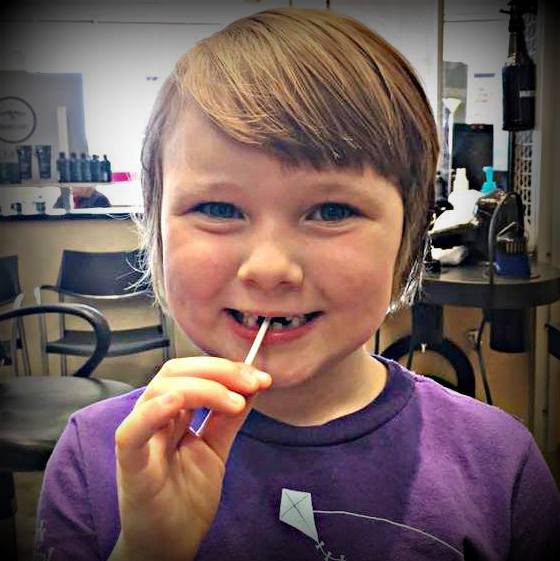
Clementine is like a pair of hands, she is known for staking claim on people, things, and new territory, like a bear. Once I found she moved all of her belongings into my bedroom, in an attempt to colonize. Things didn’t explicitly have Mom written on them was her explanation. She believes in claiming things. Once she marks you, you are a part of her territory, and she is fiercely protective. She looks out for her own, often behaves like a little mom, to her sister’s annoyance. But the hand she lays on things is of love, she wants to keep you secure & close.

Nora is like a pair of feet. Since she was old enough to crawl to me, upon coming home she always demanded to engage in play before we could do anything else. Nora’s games often involve the adult running themselves ragged, while she sits and laughs, expending little energy. Don’t leave anything out or it becomes a material in her world to smear on the walls. She’s a kid who enjoys all things messy. She likes seeing things move, people, things, thoughts, feelings. She is a kid that wants to set the world into motion, to take static things, the neat and organized, and fill them with a spirit of action.

Having gifted girls often means there is competition when one is praised. The other speaks up, “What about me?” Fearing that raising up one will bring down the others. Many of us fear this I think. But scripture like a mama bear says, “if the ear would say, "Because I am not an eye, I do not belong to the body," that would not make it any less a part of the body.” You are not any less part of the family for being different. Although sometimes, when each bear wants her way it can feel like that.

In our family, Gabby, the Three Bears' Goldilocks, often knows how to bring us all together. She is a unique pair of eyes. She reminds us that we need one another, especially when we all are demanding things go our own ways. She reminds the den: “The eye cannot say to the hand, "I have no need of you," nor again the head to the feet, "I have no need of you." On the contrary, the members of the body that seem to be weaker are indispensable.” She helps each of us, including me, see fault lines as scars on the road to healing, to see hope and wholeness in the worst of divisions, to see the old in new ways.

_________________________


The Reverend and the Doctor
_________________________

Our scripture today is all about seeing the old in new ways. In seeing the scripture in our family, in the passion of our faults, in the testament of our differences, in the commandments of our love, all saying that we are one body with many members.

But as many of us know, it is our family and even our bodies that challenge us most. In our scripture today, Jesus was visiting his hometown and synagogue. Do some of you know what its like to go away for a time and then come back to the church where you grew up? How many of you came back to the church a new person with a new vision. As long as Jesus followed the “usual” customs he was going to be safe.

But what does Jesus do? He reads from the book of the prophet Isaiah, words familiar to those listening but shows it to them with new vision. “The Spirit of the Lord is upon me, because he has anointed me to bring good news to the poor. He has sent me to proclaim release to the captives and recovery of sight to the blind, to let the oppressed go free, to proclaim the year of the Lord's favor.” The year of God’s favor was called the year of Jubilee. Every 50th year Jews were called to forgiveness and liberation. All debts were released, the poor were to be emancipated from slavery, all prisoners were to be released, and even physical impairments would be healed. Jesus reads Isaiah for a reason. Isaiah’s prophetic words foretell what will happen when the anointed one would come, the Messiah, the one who would restore Israel to God’s Vision.

Jesus finishes reading and says to them, “Today this scripture has been fulfilled in your hearing.” Folks just stare at him, wondering what this all means. He likely received blank stares. Some of you may know what this feels like, when you return home, to see family, to an old church and you are saying things that shake things up and people are clearly uncomfortable.

Jesus is challenging the status-quo, the forces that maintain that some folks have more worth or value than others. Jesus is challenging who’s in and who’s out, in his own hometown. Jesus is communicating God’s Vision of Wholeness. We’re not leaving anyone out! We will live out being open and affirming!

This revolution Jesus is calling for, is one that he knows folks will run from, it terrifies them, and yet he begins in his hometown. Where he had the greatest potential for criticism, and folks questioning his identity. Jesus is coming out to them, saying things he’s never said to them before, laying it out on the table. People who know us, who knew us from our youth, are the hardest to come out to. Because they want to keep you as they knew you. As safe, domesticated, if sometimes troubled children. They want to keep what they knew rather than turning to face the strange. This was Jesus’ challenge sharing the good news, the radical welcome laid out in God’s Vision, how could he share this good news without rejection? How do we challenge people to welcome the rejected? And this is what the people do to Christ. They run him out of town. They take Christ literally out of their lives. How do we respond?

How do we see ourselves as Christ sees us without domesticating ourselves, without falling back on divisions in order to give us the feeling of safety?


_________________________


Clementine
_________________________


This last week we celebrated Martin Luther King Jr, a man who knew something about the dangerous promise of seeing us as Christ sees us, seeing how in the scripture of our family, in the passion of our faults, in the testament of our differences, in the commandments of our love God calls down with radical inclusivity that we are one body with many members.

In the famous “Letter from a Birmingham Jail” the Rev. Dr. Martin Luther King, Jr writes about his disappointment with the domesticated white moderate saying:

(1)“who is more devoted to "order" than to justice; who prefers a negative peace which is the absence of tension to a positive peace which is the presence of justice… who… believes he can set the timetable for another man's freedom; who lives by a mythical concept of time and who constantly advises [the oppressed] to wait for a ‘more convenient season.’”

Some would say that hiring a queer pastor, enacting serious support for transgender persons is too much too quick. Some would beg us to wait, slow down, so we can hold onto our hate or fear a little bit longer. But this holding on to hate is what Christ and Martin Luther King Jr. says is killing us, killing black and queer and trans youth in the streets or alone in despair, and is killing us all spiritually. Waiting can be a sensible compromise, and radicalness can go too far, but we cannot wait to affirm life and we cannot go too far in the work of love. Love, as the late David Bowie tells us, challenges us to care for those on the edge of the night and in so loving to care for ourselves. It is never too soon to see the ignored, it is never too much to heal the wounded, there is no peace without justice, especially when we see ourselves in the isolated, suffering, and devalued. It is never beyond Christianity to see as Christ sees.

Dr. King continues: 2) “There was a time when the church was very powerful. It was during that period that the early Christians rejoiced when they were deemed worthy to suffer for what they believed. In those days the church was not merely a thermometer that recorded the ideas and principles of popular opinion; it was the thermostat that transformed the mores of society. Wherever the early Christians entered a town the power structure got disturbed and immediately sought to convict them for being "disturbers of the peace."

At youth at General Synod this past summer our young people, some from this congregation attended a UCC Polity and History class with the Rev. Dr. Jeremiah Wright, who with Rev. Bernice Jackson spoke about the civil rights movement, and other movements such as the Occupy Movement and the Black Lives Matter Movement as all having a common thread. They were begun by young adults who were tired of standing by, doing nothing to make society change. They reminded us if you don’t have a mortgage it’s much easier to join the movement, you’re more willing to take risks for your own or another’s liberation.

The revered Dr. King continues his argument: 3) “Things are different now. The contemporary church is so often a weak, ineffectual voice with an uncertain sound. It is so often the arch supporter of the status quo. Far from being disturbed by the presence of the church, the power structure of the average community is consoled by the church's often vocal sanction of things as they are.”

We have the impulse to turn away from MLK’s honest critiques, embarrassed that now over 50 years later, his message is still relevant, that Christ’s call two millennia later is still desperately needed, that in the scripture of family, the passion of our faults, in the testament of our differences, in the commandments of our love, we still need help to see ourselves as God sees us: as one body with many members. But in closing I say for us all: “the members of the body that seem to be weaker are indispensable.” We are not unchristian for our brokenness and divisions for it is ever by Christ through those that the Church is continually resurrected. There is hope. We are the Church of the poor. We are the Church of resurrection. And Hope is always with us. Amen.


_________________________


Nora
_________________________

_________________________


The family reading together
_________________________