Showing posts with label operation. Show all posts

Sunday, November 2, 2014

Scars of the Pardoner: The Trans-Operative (3/5)


“Transsexuals must take responsibility for all of their history 
... as a political action begun by reappropriating difference and reclaiming the power of the reconfigured...body.”

Sandy Stone
The Empire Strikes Back: 
A Post-Transsexual Manifesto

*************************************

Responding to histories that naturalize the division and erasure of polemic gender, a critical trans project recollects fragmented parts of bodies, communities, and histories in order to redeploy their treacherous operation against the foreclosing of alternative futures. In this work I follow Stone’s argument from “The Empire Strikes Back,” rejecting the progressive premise that trans bodies should be historically limited by cuts dividing their personal and collective existence. “I suggest,” writes Stone, “constituting transsexuals not as a class or a problemic third gender but rather as a genre – a set of embodied texts whose potential for productive disruption of structured sexualities and spectra of desire is yet to be explored.”[i] In what I term a “trans-operative” mode, history is not a descriptive categorization of time into a series of pre-/post-eras, but instead a productive literary act of reading and composition that works by betraying divided alliances, opening access and appropriating historically divided technologies, bodies, and texts, such as Matthew 19:12.

The trans-operative recollection of history is distinct from a project of restoration refusing born this way politics that positions trans persons as “eunuchs from birth.” The argument for a third sex haunts discussions of castrates, appearing to offer an alternative besides men or women, yet by conflating trans bodies into one uninterrupted continuum, the distinct pleasures and violence are forgotten, perpetuating yet another project of erasure. Instead of attending to operations, or in the case of doctors refusing to allow access to operations, they become a mere discourse of words, “ongoing struggles over beliefs and practices within academic and medical communities… far removed from the body” (229). Whether under the name eunuch or transsexual, hermaphrodite or intersex, crafting an ahistorical third gender inevitably cuts out countless bodies and voices.

*************************************
*************************************


Likewise, the trans-operative resists progressive campaigns to become naturalized citizens in the political gender map as an artificial third party, “made that way by men.[ii]” This liminality makes castrates targets for enlistment as operatives to reinforce divisions between men and women, past and present regulating our operations to conditions set by the contemporary forces that construct and limiting us to “something less than agency. ”  [iii] Contemporary castrates come to accept a place as the constructed gender in contrast to the naturalness of men and women who point to the work transgender politics and history wondering, “don’t you think we think too much about gender?” Thus, while transgender politics often accepts a place as post-modern, post-op sex, the history of castration that has made us, written as scars on our skin, demands we reassess these operations. “Is the surgery performed to create a ‘normal’… body after all?” asks Butler, “The mutilations and scars that remain hardly offer compelling evidence that this is accomplished.”[iv] 

A trans-operative approach demands that we sustain access to history by allowing persons to “make themselves eunuchs,” appropriating figures from the past and allowing texts to claim them to carve out their own genres of embodiment and narrative, following Stone’s call, “To begin to write oneself into the discourses by which one has been written.”[v] This method treats history as a “productive” venture rather than a merely description one. As has been demonstrated, history can be double-edged work, creating relations that utilize bodies without acknowledging their distinct presence and labor. It seeks not add something wholly anachronistic to the archive but by reading the scars of erased histories for places where the absences reopen texts to the work recollecting stolen bodies, challenging the finality of periodization, and producing access between parts of a dispersed continuum. 

*************************************
*************************************

Disturbing the barriers formed by progressive histories and operations demands that we implicating us in the ongoing relations between past and present. “Transsexuals must take responsibility for all of their history,” writes Stone, “to begin to articulate their lives not as a series of erasures… but as a political action begun by reappropriating difference and reclaiming the power of the reconfigured and reinscribed body.”[vi] Following Stone, a trans-operative approach acknowledges its agency is dispersed across supposedly discrete sides of a divide: man and woman, doctor and patient, before and after, knife and skin. As operatives are implicated across all sides, citing responsibility for how our bodies have been used and reappropriating the technologies that have divided our collective material and historical relations. To accomplish this, we must discern, first, how bodies are made instruments of castration and the erasure of history and, second, how recollection of fragments open up new potential for life across division.

Taking responsibility for history involves acknowledging the harm that operations have done beyond the scope of the 20th century, insisting that medieval studies and trans studies are not tangentially related but inextricable. Castrates across time help to replicate more castrates and more kinds of surgery, whether or not they were complicit in these operations and their reproduction, by being made into docile bodies for the development of technologies of the knife. This suggests that by internalizing the inscription of barriers as necessary for personal and social health and participating in an a progressive history, we are all implicated not only in the coercion of intersex and trans bodies into clinics but diverse manners of laying hands on another body. A trans-operative approach to texts recollects how this divides reproduce one another to testify that the scars that cut across countless bodies remain rooted in our collective skin and we are answerable to them.

*************************************
*************************************

The recollection of discarded parts of history can constitute an act of liberation by reclaiming access to our divided bodies and affirming that temporal limits placed on lives are not insurmountable. It must be noted that this work is never done without threatening the supposed security provided by the partitioning of time and bodies into discrete fields. Those who have internalized these divisions may feel that agitators have become traitors, political operatives threatening the safety such boundaries promise, keeping unresolved problems safely in the past where we no longer have to think about them. Progressive politics claim to bury social operations such as castration and slavery in the past, but in the process often buries their victims along with them. The recollection of fragments and the production of new genres of relation to erased histories are worth the dangers of reopening scars to help our collective bodies “rise from off of the doctors slab, like Lazarus from the pit,” to find new life in politics and cultural memory. 

Turning now to appropriate the Pardoner from the Canterbury Tales, for a trans-operative history, I re-open a discourse that proponents of progressive history, like Chaucer’s Physician, may want closed. In “the Pardoner’s (Over-)Sexed Body,” Robert Sturges discusses those who argue that we think too much about the Pardoner’s gender, try to fix the Pardoner by taking him to be a eunuch, cutting off problematic parts and readings of his body in the process.[vii] Such readings note his effeminate features, high singing voice, role in the Church, origin in the Mediterranean, and the ominous note that he is either a “gelding or a mare.”[viii] Each of these readings inscribe themselves on the history of the text, yet none of them erase the other scars of the Pardoner. Instead, a trans-operative approach demands that we do not try to pardon the past by erasing it nor try to make it pardon us by repeating operations that cut up bodies and cut off lives.

*************************************
*************************************
Part 1: A Physician's Tale
Part 2: A History of Castration
Part 4: The Physician's Surgery
Part 5: The Pardoner's Scars
*************************************
*************************************

[i] Stone. “The Empire Strikes Back,” 231. 

[ii] See: Taylor, Gary. Castration, 154; Kuefler, “Castration and Eunuchism,” 186; Tracy, “A History of Calamities,” 7-9. 

[iii] Stone. “The Empire Strikes Back,” 229. 

[iv] Butler. “Doing Justice to Someone,” 187. 

[v] Stone. “The Empire Strikes Back,” 232. 

[vi] Stone. “The Empire Strikes Back,” 232. 

[vii] Robert S Sturges. “The Pardoner’s (Over-)Sexed Body.” Chaucer’s Pardoner and Gender Theory. N.Y. St. Martin’s Press. 2000. 35-46. 

[viii] Chaucer, “The General Prologue,” 691.


*************************************
*************************************

Friday, October 24, 2014

Scars of the Pardoner: A History of Castration (2/5)


"Transsexuals... become castrati, 
extol this operation as a liberation"

Piotr O. Scholz
Eunuchs and Castrati

*************************************
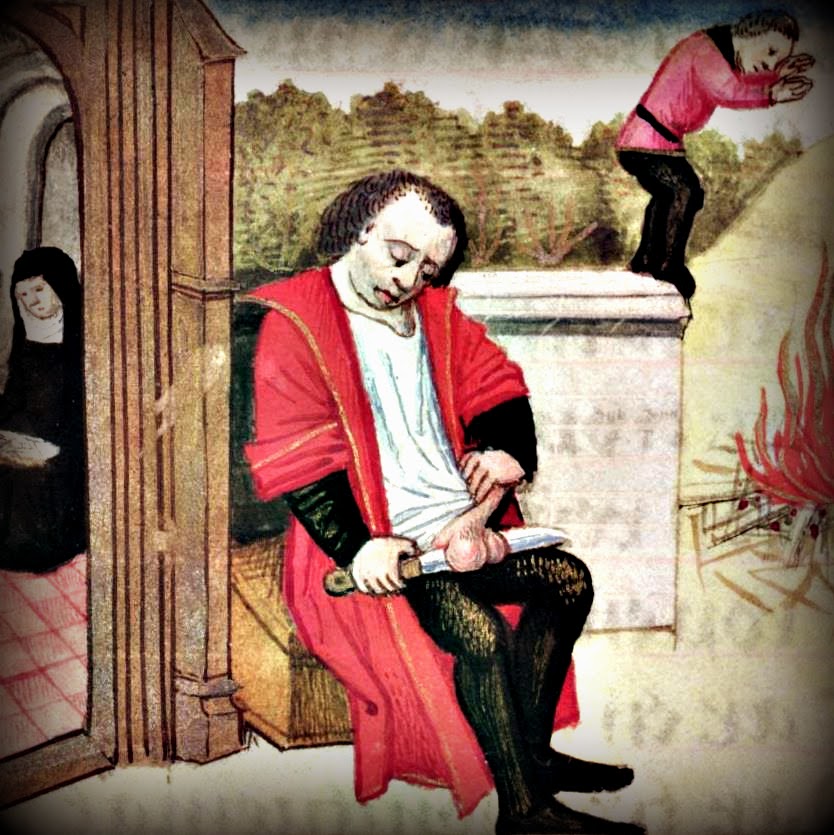
“The trans-historical focus of most works on castration,” notes Matthew Kuefler, “reminds us that eunuchs in medieval European society had a history stretching back much further than the beginning of the Middle Ages.”[i] The same goes for the modern transsexual, I argue. A genealogy of surgery can be traced via the scar tissue of castrates with an archeological record of skin from a doctor’s office in 21st century America, through medieval Europe and beyond, demonstrating that the violence of laying hands on another is not accidental in the evolution of surgery but congenital to its cultural work.[ii] Since Classical medicine, surgery has operated by coding certain bodies as “the parts” (that which is discarded), while coding others as “the whole” (that which is preserved).[iii] A progressive history of a body is made by eliminating the prior for the sake of the later. In the case of castration, testicles, and sometimes phalluses, were cut off in what began as a cure for illness or wounds but became a way of controlling spiritual and temporal life.[iv]

Before spread of castrates throughout Europe in the form of eunuchs and castrati, the act of castrating a servant to produce specific changes, e.g. making him sterile or keeping his voice from dropping, was an operation that cut across cultural boundaries. Adopting by Byzantium from the Greco-Romance, when various Muslim states claimed the region, the practice of utilizing eunuch servants were adopted and spread throughout conquests in Asia and Eastern Europe.[v] The job of enslaving and surgically producing eunuch servants, however, largely fell to Christians, particularly monasteries, who collected, castrated, and sold eunuchs.[vi] The work of these operations on and through these slaves moved around the Mediterranean encouraging the spread not only physical surgery but social practices aimed to erase old sexual, national, and religious identities.[vii]


*************************************
*************************************


“The English word eunuch derives from the ancient Greek,” writes Gary Taylor in his Abbreviated History of Castration, from a compound of words “meaning ‘bed,’ especially ‘marriage bed’” and “to hold, keep, guard.”[viii] Thus, giving the name eunuch, meaning “guardian of the marriage bed,” to castrates inscribed their liminal sexual position between the supposed purification of the body at castration and the persistence of a post-op body full of potential for alternative sexual lives.[ix] At the heart of social application of the eunuch was the portioning the body at castration that sterilized bodies to make the reproduction of its genetic line into the future unlikely. Their futurity cut off, eunuchs became physical and social stand-ins for lords when they were absence from the manor. While losing the power to reproduce, eunuchs could often still have erections, making them ideal sex slaves for the wives of powerful lords: able to satisfy lust without threatening the line of succession. The eunuchs services depended on his continued possession of a sex and sexuality that is nonetheless socially erased.

Because he could not create his own line of heirs and was thus dissuaded from attempting to amass large stores of personal wealth, the eunuch was considered a safe trustee for the Lord’s possessions, managing servants, the estate, armies and Churches.[x] The castrate was used not only to police gender politics between wife and husband, but this liminal position made the castrate at once the mechanism of cultural erasure and the keeper of the socially divided parts of the community. Administrators of the Latin Church soon discovered the castrate’s instrumental social value in managing sex and temporal politics. By the late middle ages, as high voiced castrati were being integrated into choirs of Rome, the castrate had come to represent a body several times denied, lingering only as unseen singers and prayers to serve the futurity and salvation of others.

*************************************
*************************************

While by the 14th century, eunuchs and castrati were still not an active part of the historical record of England, other operations and castrate bodies were being produced through a more punitive extension of the expulsion logic of castration and surgery. As in neighboring regions, e.g. France and Germany, England adopted castration as punishment for legal and spiritual transgressions of sex, such as in the castration of Peter Abelard for his erotic relationship with a nun, Eloise.[xi] Because older laws dictated that rape, infidelity, or sodomy could be punishable by death, the alternative of castration was seen as a merciful development.[xii] While laws punishing sexual crimes across Europe varied, but punishments frequently returned to the tropes of dismemberment and death by scarring, burning, and castration.[xiii] In each of these cases, we see progressive logic of surgery being developed in medieval England, cutting up parts of the body supposedly to save the physical and spiritual wholeness of society.

While medical doctors enacted the physical violence, Doctors of the Church, such as Peter Abelard, were instrumental in making castrates into tools for spiritual operations. While Abelard’s castration followed closer to the line of being “made that way by men,” her drew on Mathew 19:12 to encourage chastity, where penitents literally or figuratively “make themselves eunuchs for the kingdom of heaven.”[xiv] Since the medieval period, interpretations of this passage find a renunciation of one’s body, sexual identity, and past for the sake of purifying closure, erasing the sexual abilities of the castrate. Thus, despite continued erotic correspondence with Louise, Abelard wrote that castration freed him to pursue a heavenly eternity unencumbered by demands to think temporally about gender and sexuality.[xv] The violence on Abelard cut deep, internalizing a sense of division and making him an advocate for the development of more such operations.

*************************************
*************************************

By the late Middle Ages, medical, legal, and spiritual surgeries were inextricable, working in congress under “Christus Medicus” (Christ as Physician) or “oure soules leche” as the Pardoner names Him.[xvi] Drawing on the cures and teachings of Jesus, such as Mathew 18:9, “if your eye causes you to stumble, gouge it out and throw it away,” and Matthew 19:12, this doctrine could be used to excuse Christians to lay hands on another if the violence could be justified as promoting the spiritual health of a person or society.[xvii] “The opinion of ancient science that castration,” Mathew Kuefler notes, “could cure or at least alleviate ailments also made its way into medieval science.” Despite religious prohibitions against deforming the integrity of a body, castration, was “permissible mutilation if used to save the whole person.”[xviii] With the castrate as a sign of a purged past, society could excuse a wide array of violent operations including producing eunuchs in monasteries, purging Byzantium and the Holy Land, and castrating prisoners.[xix] 

A brief history such as this is insufficient to account for the tiniest part of the lives captured in the social operation of sharp machines, but can at least testify that in the scars of castrates we find a genealogy implications not only on the development of sex change operations but a wide array of physical and social partitioning of bodies across time. Beyond eunuchs and castrati, castration has developed into the surgical and chemical sterilization of racial minorities and people with disabilities.[xx] The reconstruction of genitals continues to police gender through circumcision, genital mutilation, and operations on intersex children.[xxi] Punitive surgery has served as precedent for later legal and social violence, “corrective” rape, and the internalized shame that prompts suicide.[xxii] A critical trans history of the scars of castration cannot be limited to the castrate but all those bodies on and through whom the violence of sharp machines operates. 

*************************************
*************************************
Part 1: A Physician's Tale
Part 3: The Trans-Operative
Part 4: The Physician's Surgery
Part 5: The Pardoner's Scars
*************************************
*************************************

[i] Matthew S Kuefler. “Castration and Eunuchism in the Middle Ages.” Handbook of Medieval Sexuality. Vern L Bullough and James A Brundage ed. N. Y.: Routledge, 2000. 280. 

[ii] “Emasculated men, usually described incorrectly as eunuchs, can now be found among transvestites, transsexuals, and other members of various sects … Some who consider themselves transsexuals in the West, although they have actually become castrati, extol this operation as a liberation.” Piotr O. Scholz. Eunuchs and Castrati: A Cultural History. John A Broadwin and Shelley L Frisch trans. Princeton: Markus Wiener Publishers, 1999. 3, 234. 

[iii] Taylor, Gary. Castration: an Abbreviated History of Western Manhood. New York: Routledge, 2000. 56. Kuefler. “Castration and Eunuchism,” 286. Also cited in Tracy, Larissa. “A History of Calamities: the Culture of Castration.” Castration and Culture in the Middle Ages.5. 

[iv] Tracy, “A History of Calamities,” 5-18; Matthew S Kuefler. “Castration and Eunuchism,” 286. 

[v] Scholz, Eunuchs and Castrati,198. Tougher, Shaun. The Eunuch in Byzantine History and Society. N.Y.: Routledge, 2008. 60-65, 119. 

[vi] The castration of eunuchs was a production that was often forbidden and often ignored, with producers and slave-traders, often buying their eunuchs from foreign sources. See: Scholz, Eunuchs and Castrati,198-199. Kuefler. “Castration and Eunuchism,” 284-290. 

[vii] Scholz, Eunuchs and Castrati, 203-214, 232. Kuefler. “Castration and Eunuchism,” 280; Tougher, The Eunuch in Byzantine History and Society, 60-67, 119. 

[viii] Taylor, Gary. Castration, 33; Tracy, “A History of Calamities,” 6. Scholz, Eunuchs and Castrati, 232. 

[ix] Tracy, “A History of Calamities,” 4-11. Taylor, Castration, 33-36; Kuefler. “Castration and Eunuchism,” 282-285. 

[x] Tougher, The Eunuch in Byzantine History and Society, 54-82. Taylor, Castration, 32-39. Kuefler. “Castration and Eunuchism,” 282-292. Tracy, “A History of Calamities,” 4-9. Scholz, Eunuchs and Castrati, 200-209. 

[xi] Peter Abelard’s castration has been the topic of numerous articles and chapters. Irvine, Martin. “Abelard and (Re)Writing the Male Body: Castration, Identity, and Remasculinization.” 87-106; Wheeler, Bonnie. “Origenary Fantasies: Abelard’s Castration and Confession.” 107-128; Ferroul, Yves. “Abelard’s Blissful Castration.” 129-150. Becoming Male in the Middle Ages. Jeffrey Jerome Cohen and Bonnie Wheeler ed. N.Y.: Gardland Publishing, Inc., 2000; Tracy, “A History of Calamities,” 9-19; Tougher, The Eunuch in Byzantine History and Society, 11; Scholz, Eunuchs and Castrati, 246-255; Kuefler, “Castration and Eunuchism,” 289-290. 

[xii] Numerous scholars discuss both the use and resistance to the punitive use of castration in European law: Kuefler, “Castration and Eunuchism,” 287-289; Tracy, “A History of Calamities,” 19-28; Irvine, “Abelard and (Re)Writing the Male Body,” 96-99; Bremmer Jr, Rolf H. “The Children He Never Had; the Husband She Never Served: Castration and Genital Mutilation in Medieval Frisian Law.” Castration and Culture in the Middle Ages. 108-130; Taylor, Gary. Castration,52-55. 

[xiii] Johansson, Warren and William A Percy, “Homosexuality. ” Handbook of Medieval Sexuality. 168-175; Tracy, “A History of Calamities,” 19-24; Kuefler. “Castration and Eunuchism,” 286-290. 

[xiv] Scholz, Eunuchs and Castrati, 160-164. Kuefler. “Castration and Eunuchism,” 282-286. Tracy, “A History of Calamities,” 12-13. 

[xv] Irvine, “Abelard and (Re)Writing the Male Body,” 87-106; Wheeler, “Origenary Fantasies,” 107-128; Ferroul, “Abelard’s Blissful Castration,” 129-150; Tracy, “A History of Calamities,” 9-19; Tougher, The Eunuch in Byzantine History and Society, 11; Scholz, Eunuchs and Castrati, 246-255; Kuefler, “Castration and Eunuchism,” 289-290. 

[xvi] oure soules leche” Chaucer, “The Pardoner’s Tale,” 916. For more on Christ as Physician see: Arvesmann, Rudolph. “The Concept of ‘Christus Medicus’ in St Augustine.” Traditio. Vol. 10. N.Y.: Fordham University, 1954. 1-28. 

[xvii] Matthew Taylor, Castration, 72; Tracy, “A History of Calamities,” 9-10; Kuefler, “Castration and Eunuchism,” 282-283; Tougher, The Eunuch in Byzantine History and Society, 68-82; Scholz, Eunuchs and Castrati,159-164. 

[xviii] Kuefler. “Castration and Eunuchism,” 286. Also cited in Tracy, “A History of Calamities,” 5. 

[xix] Castration and violent operations tended to work in junction and reflect a wide variety of social contests over bodies, property, and beliefs, while rarely gaining the status of becoming a standard response. As Tracy notes, “The desire to use castration as a way of stamping out foes undermines notions of inherited right and suggest a deeper instability within power structures. Like torture, castration is a weapon employed by the weak: those hose hold on power is tenuous or questionable,” Tracy, “A History of Calamities,” 19-24. See also: Tougher, The Eunuch in Byzantine History and Society, 119-127; Scholz, Eunuchs and Castrati, 198-234. 

[xx] For more on the sterilization of racialized and disabled persons see: Mitchell, David and Sharon Snyder. Cultural Locations of Disability. Chicago: University of Chicago Press, 2006. Chesterton, G. K. Eugenics and Other Evils: An Argument against the Scientifically Organized State. Ed. Michael W. Perry. Seattle: Inkling, 2000. Print. Lewis, C. S. "The Humanitarian Theory of Punishment." God in the Dock: Essays on Theology and Ethics. Grand Rapids: Eerdmans, 1970. 287-300. Print. 

[xxi] Numerous debates on circumcision continued throughout the middle ages and after, as noted by Kuefler, “Castration and Eunuchism,” 184. Intersex surgery on hermaphrodite/intersex children were in regular use, they were conceptually folded in as “eunuchs from birth” and continue today: see, Tougher, The Eunuch in Byzantine History and Society, 31-32; Kuefler, “Castration and Eunuchism,” 286; Scholz, Eunuchs and Castrati, 5-13; Chase, Cheryl “Hermaphrodites with Attitude: Mapping the Emergence of Intersex Political Activism,” The Transgender Studies Reader, 300-314; Winkerson, Abby L. “Normate Sex and Its Discontents.” Sex and Disability. Robert McRuer and Anna Mollow ed. London: Duke, 2012. 183-207. 

[xxii] See Raymond, Janice. “Sappho by Surgery: the Transsexually Constructed Lesbian-Feminist.” The Transgender Studies Reader. 134; Winkerson, “Normate Sex and Its Discontents,” 183-207.


*************************************
*************************************